
Chad Smith
Race To Egg: How Sperm Competition Drives the Evolution of the Sexes.


Why do males produce so many sperm? While Charles Darwin is famous for explaining how male competition for females could lead to the evolution of male ornaments and weapons, he did not foresee that competition could continue after mating is over. In this talk we’ll explore how competition between sperm from more than one male for the fertilization of the eggs can have widespread effects on male behavior, anatomy, and of course the characteristics of the sperm itself. In addition, we now recognize females can play an important role in determining the outcome of sperm competition, and as a consequence we’ll talk about female role in this process.
Click here to download the poster from Chad’s SUTS Event!

Laura Dugan
Aliens Among Us: Invasive Species.
What are they, what do they do and what can we do about them?

Laura Dugan at Posa Azul, Cuatrocienegas, Mexico

The invasive Jewel Ciclid.
Invasive alien species (IAS) are recognized as one of the greatest threats to global biodiversity. In today’s modern world, species are moved all over the globe via intentional and unintentional means. Many of these species are never able to establish and spread in their new environments, but those that do can wreak havoc on native communities via a variety of interactions including predation, competition and hybridization. In this talk, I will discuss a few of the effects of invasive species and introduce some of the major Texas invaders. I will also discuss some of the methods that are currently being used to combat invasive species as well as genetic biocontrol technologies that are being investigated as potential amelioration techniques, some of which have already been put into practice in Australia.
Click here to download the poster from Laura’s SUTS Event!

Taylor Sultan Quedensley
Lichenized-fungi of Texas: Biology, Ecology, and Distribution of a Diverse Group of Understudied Organisms
Lichens are a diverse group of organisms in Texas, occupying many different types of habitats throughout the state. There are over 500 species reported for the state, and the number is undoubtedly greater considering the relatively low amount of collecting that has been conducted. With a diverse flora and fauna well-reported for Texas, lichens also need to be included in the discussion of the state’s high biodiversity levels, and also towards developing conservation strategies for threatened ecosystems.
Sarah Davies & Carly Kenkel
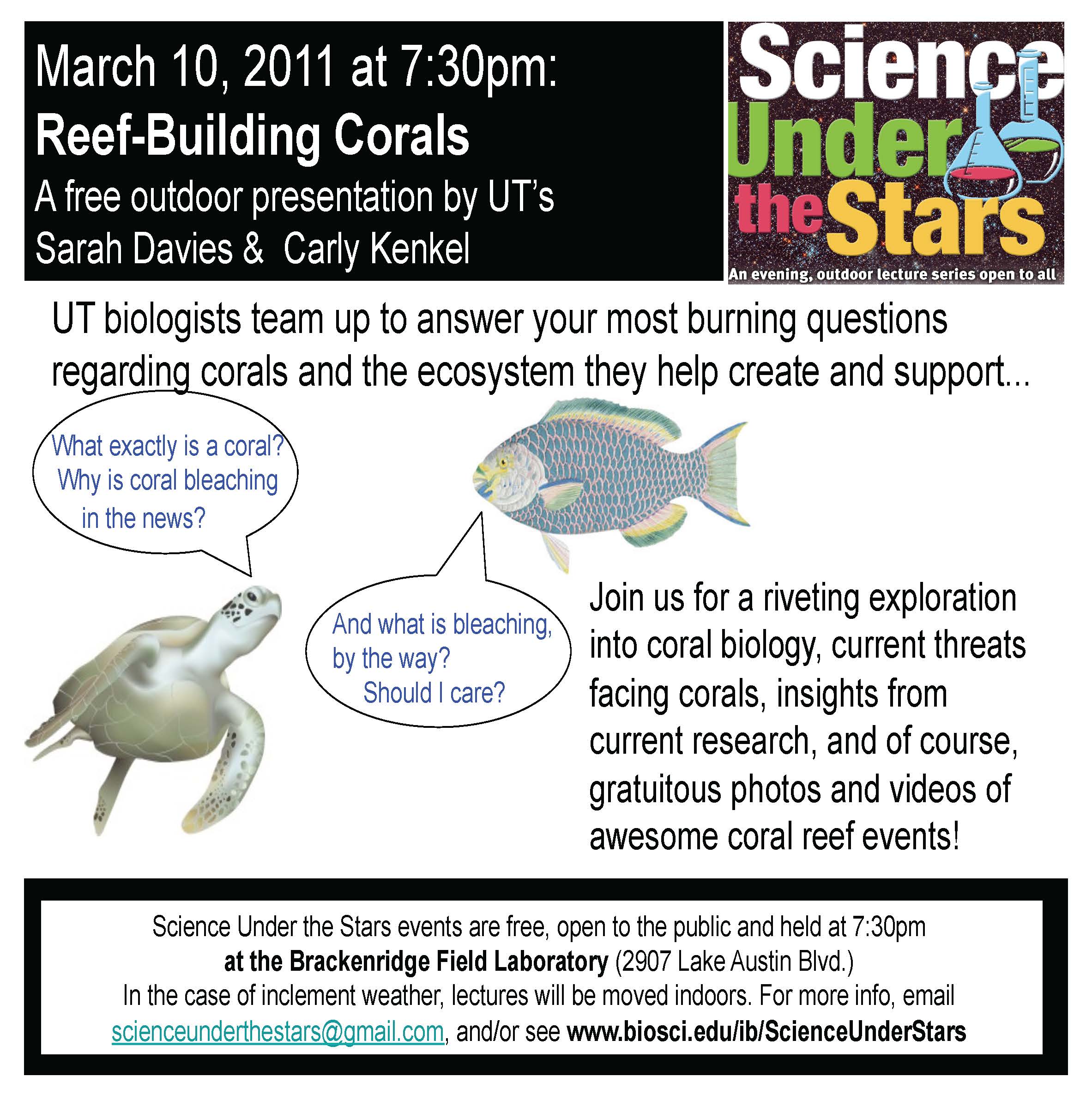
Reef-Building Corals

UT biologists team up to answer your most burning questions regarding corals and the ecosystem they help create and support…
Join us for a riveting exploration into coral biology, current threats facing corals, insights from current research, and of course, gratuitous photos and videos of awesome coral reef events!
Click here to download the poster from Sarah & Carly’s SUTS Event!
Larry Gilbert
Organisms across a dynamic landscape: Reflections on the natural and unnatural history of Central and Southern Texas
This lecture is focused on the southern Texas ecosystem where the speaker Larry Gilbert grew up. Much of the region lacks permanent streams and has a highly unpredictable climate. These factors shaped the ecology and natural history of organisms (including people) in the area known as the brush country. Explorer’s accounts from the early 16th century to the early 19th century allow interpretation of certain myths about the vegetation that have shaped management tactics from the 1950s. Conservation of diversity in this region will rely on a certain amount of myth busting along with private initiatives to recognize and retain remaining tracts of native landscape matching earliest accounts. Economic incentives to conserve natural landscapes in the region include hunting and holistic range management for cattle production. Fragmentation of large private ranches is encouraged by inheritance taxes. Tax “write-offs” for “range improvement” encourage removal of natural vegetation. Legal mechanisms to reverse such trends would indirectly promote conservation of remaining tracts of quality habitat.



 Science Under The Stars