
Neighborhood Science at Twin Oaks Branch Library
Science Under the Stars has expanded to include the Austin Public Library! At Neighborhood Science, previous SUTS speakers will present at different library branches around the city a couple times a month. Below are the dates and descriptions for this fall at the Twin Oaks Branch Library, 1800 S 5th St, Austin, TX 78704. All talks begin at 7pm.
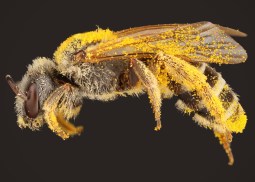
A Sweat Bee native to Texas covered in pollen. credit: Alejandro Santillana, Insects Unlocked
Thursday, October 3, 7pm: Megan O’Connell – “Bees go grocery shopping”
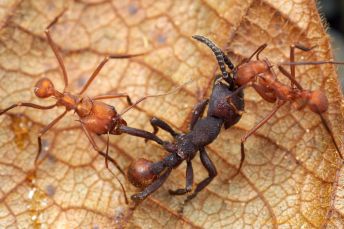
Leafcutter ants defending their nest against an army ant. Credit: Alex Wild Photography
Thursday, November 7, 7pm: Tristan Kubik – “Clash of the Myrmidons”
The Amazon rainforest is home to two unexpected titans. Leafcutter ants are peaceful, sedentary farmers responsible for processing huge volumes of tropical vegetation. They use their foraging material to cultivate obligate, fungal nurseries that cradle precious brood deep within their subterranean fortresses. Few organisms are courageous or capable enough to threaten mature leafcutter colonies, but the tank army ant is one of them. Tank army ants are nomadic, subterranean ant-killing machines. Their colonies can reach as many as several million and their hunger for leafcutters is insatiable. They flush out and overwhelm kilograms of prey every day with their numbers, mandibles, and venomous stings. And yet, leafcutter nests are not without defenses. Leafcutter colonies rapidly mount impressive responses to the alarming presence of tank army ant scouts including specialized soldiers, construction of barricades, and air-tight linear battlefronts. These two large, complex, derived societies clash in epic battles akin to the wars waged long ago by the Greeks and Romans with heroes just as notable as Hercules and Achilles. Such examples of social conflict are of great interest to systems science and parallels can be drawn to instances of immune systems vs disease, competing economies, and even human warfare. Join me for a night of bravery, sacrifice, and storytelling as I share my passion and knowledge about this riveting rivalry!
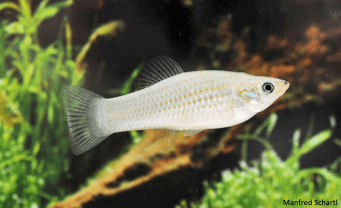
Amazon molly (Poecilia formosa), an all-female clonal fish
Thursday, December 5, 7pm: Allison Davis – “How to get a date: story of a clone”
Neighborhood Science at Howson Branch Library
Science Under the Stars has expanded to include the Austin Public Library! At Neighborhood Science, previous SUTS speakers will present at different library branches around the city a couple times a month. Below are the dates and descriptions for this fall at the Howson Branch Library, 2500 Exposition Blvd, Austin, TX 78703. All talks begin at 7:30pm. **These talks will be held outdoors, so bring a chair!
A Sweat Bee native to Texas covered in pollen. credit: Alejandro Santillana, Insects Unlocked
Tuesday, September 24, 7:30pm: Megan O’Connell – “Bees go grocery shopping”
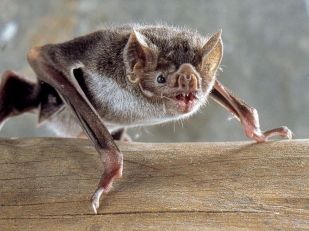
Bats use sonar to see. Credit: Uwe Schmidt
Tuesday, October 29, 7:30pm: Caitlin Leslie – “Sensory Superheroes: Extreme Animal Sensory Systems”
Tuesday, November 26, 7:30pm: Chase Rakowski – “Plankton: the little alien-like creatures that might save us all”
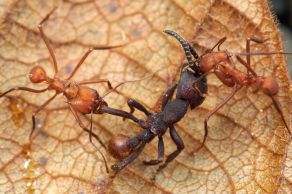
Leafcutter ants defending their nest against an army ant. Credit: Alex Wild Photography
The Amazon rainforest is home to two unexpected titans. Leafcutter ants are peaceful, sedentary farmers responsible for processing huge volumes of tropical vegetation. They use their foraging material to cultivate obligate, fungal nurseries that cradle precious brood deep within their subterranean fortresses. Few organisms are courageous or capable enough to threaten mature leafcutter colonies, but the tank army ant is one of them. Tank army ants are nomadic, subterranean ant-killing machines. Their colonies can reach as many as several million and their hunger for leafcutters is insatiable. They flush out and overwhelm kilograms of prey every day with their numbers, mandibles, and venomous stings. And yet, leafcutter nests are not without defenses. Leafcutter colonies rapidly mount impressive responses to the alarming presence of tank army ant scouts including specialized soldiers, construction of barricades, and air-tight linear battlefronts. These two large, complex, derived societies clash in epic battles akin to the wars waged long ago by the Greeks and Romans with heroes just as notable as Hercules and Achilles. Such examples of social conflict are of great interest to systems science and parallels can be drawn to instances of immune systems vs disease, competing economies, and even human warfare. Join me for a night of bravery, sacrifice, and storytelling as I share my passion and knowledge about this riveting rivalry!
Special event! September 19, Larry Gilbert
The history and role of Brackenridge Field Laboratory at 52 years and counting
Have you wondered about how and why UT Austin keeps a field lab in the middle of the city? Come on out to this special, one-time event to learn about the history and discoveries made at Brackenridge Field Lab (BFL).
In the 1880’s, leaders of Austin attempted to industrialize with hydroelectric potential of the Colorado River. George Brackenridge provided capital, and land for a dam and a quarry that provided most the dam’s structure. The quarry, abandoned in 1893, and deep silt deposits that followed the dam’s collapse in 1900, were two disturbances that ultimately created a patch of urban nature dedicated as Brackenridge Field Laboratory in 1967. This backdrop explains how BFL, as a keystone resource that fostered UT’s premier graduate program in biology, could be created although never planned for this role by city or university leadership.
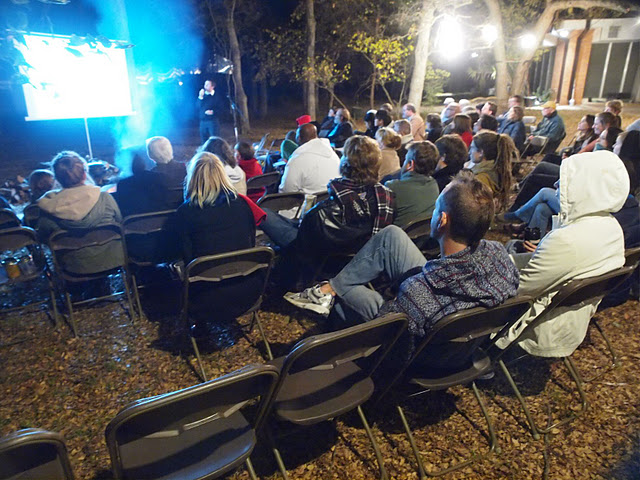
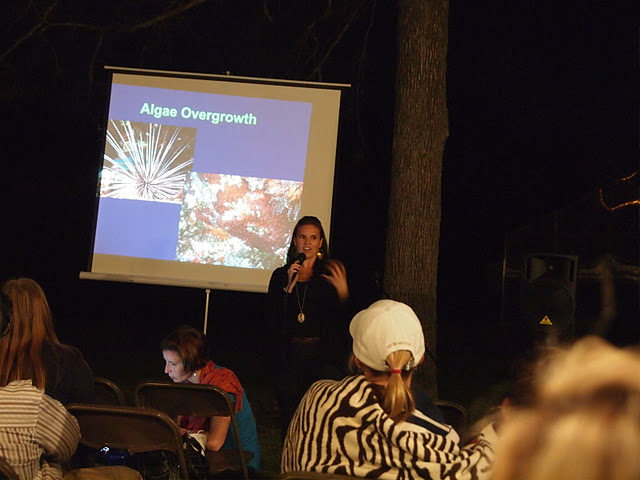
Science Under the Stars is a free public outreach lecture series in Austin, Texas. The talk will be held outdoors at Brackenridge Field Laboratory, 2907 Lake Austin Blvd, Austin, Texas 78703. Here’s the schedule for this month’s event:
- 7:00 pm: Snacks, kids activities, and displays of local animals and plants discovered at Brackenridge Field Laboratory will be available.
- 7:15 pm-7:45 pm: Guided tour of the field lab (wear sturdy shoes and bring water)!
- 8:00 pm: Settle in, because the talk begins now!
- 8:45 pm: Q&A with the speaker.
First time visitor? Please read our pet policy & field station rules here, and find parking info and directions here.
Fall 2019 Semester Schedule
It’s that time of the year, mark your calendars! We have four speakers scheduled for an exciting semester of talks, on the second Thursday of every month:
- September 12: Megan O’Connell – Bees go grocery shopping
- Special event! September 19: Larry Gilbert – The history and role of Brackenridge Field Laboratory at 52 years and counting
- October 10: Caitlin Leslie – Sensory Superheroes: Extreme Animal Sensory Systems
- November 14: Chase Rakowski – Plankton: the little alien-like creatures that might save us all
- December 12: Claire Hemingway – Brainy bats: strategies for finding food in the jungle at night
Science Under the Stars is a free public outreach lecture series in Austin, Texas. Events are held outdoors at Brackenridge Field Laboratory, 2907 Lake Austin Blvd, Austin, Texas 78703. Arrive early for refreshments and fun activities for kids of all ages!
Note: We will post the precise schedules for each event in a separate, event-specific post. Follow this link for details on the September event. Follow this blog or our Facebook page to get event notifications.
On September 19 we will be hosting a special event on the history and importance of Brackenridge Field Lab. If you’ve wondered why and how UT has maintained a field lab in the middle of the city and what has been discovered there, come on out! Details here.
May 16th Neighborhood Science
Science Under the Stars has expanded to include the Austin Public Library! At Neighborhood Science, previous SUTS speakers will present at different library branches around the city a couple times a month.
Sarah Barfield – Permaculture principles in the sustainable food movement
Demand for sustainable, locally produced food is growing across the U.S. This movement has led to a resurgence in local farmer’s markets, urban gardening, and farms utilizing sustainable soil practices guided by permaculture principles. The results of these past and ongoing efforts to produce sustainable food have to led to incredible examples of abused land that has been restored to healthy and productive farm ecosystems. Come join us at Science Under the Stars this month if you want to learn about permaculture principles, soil biology and ecology, and more!
-
Thursday, May 16th, 7:30pm at the Twin Oaks Branch, 1800 S 5th St, Austin, TX 78704


 Science Under The Stars